Now that the excitement of the census release has begun to settle, we’re starting to get into the nitty gritty of it.
We now have options for accessing it on a few different sites
- National Archives of Ireland
- Ancestry (transcriptions plus image)
- FindmyPast (transcription plus link to image on National Archives)
- MyHeritage (transcriptions plus image)
- John Grenham (transcriptions plus image)
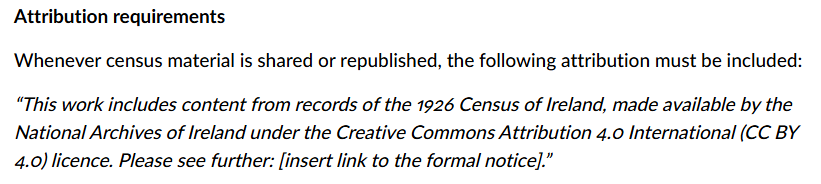
I know some readers of my blog will love a good source citation, so here’s how to understand and cite the new 1926 census. The National Archives has some guidance on this but I wanted to develop it a bit further. The census is released under a Creative Commons Attribution 4.0 International (CC BY 4.0) licence, which means it can be used by commercial and non-commercial entities. This is how the big genealogy sites have taken it and incorporated so quickly. The Creative Commons detail should be cited at least once when you’re using it.
They then give the following citation example:

There are several components, and they will be basis for all further 20th century Irish Free State/RoI census returns, so let’s break them down.
- STAT/1 refers to the relevant government department – Statistics. 1 is the first census of the Irish Free State, so presumably when we get the 1936 census, it will be STAT/2.
- County refers to the county in a numerical alphabetical order, but it’s a 32 county index, even though 6 counties are not in this census (being in Northern Ireland). I’ve listed the county codes in a table below.
- The third number is a DED code. There is no official list of DED codes because there are 2771 of them. However, these codes do appear in URL of the pdf digital image when you open it, and they also show on the B1 form, written in pencil.


- Townland or Street address
- The last section in the example says “Residents of a House Form”. I’m interpreting this as the schedule number on form B1. So in my example, I’m using the O’Shea family, who lived in Milltown, Co. Kildare. They are no 118.
- Not included in the NAI citation is the URL, but I do recommend adding this. There are a few versions of the URL, depending on how you searched for the name. Let’s look at these too:
I searched for O’Shea in Kildare and selected 10 year old Christopher at random, so the first URL shows the search parameters:
However, if I go from the single view to the household view and click on Christopher O’Shea’s name there, the url changes format. It’s a more concise version, so I recommend using this one. The number at the very end changes if you click on a different person in the household.
https://nationalarchives.ie/collections/search-the-1926-census/census-record/#a_id=684867
The PDF digital image has a different URL and it has a token in it, which means it times out, so this version is not suitable for putting into a report or family tree software. It won’t work later on.
So our full citation for the O’Shea family now reads:
Example citation: National Archives of Ireland, 1926 Census, STAT/1/14/38, Milltown, Schedule 118, O’Shea. https://nationalarchives.ie/collections/search-the-1926-census/census-record/#a_id=684867 (10 Jun 2026) Reproduced with the kind permission of the Director of the National Archives.
If you’re doing lots of references in a document, I would put the Creative Commons piece at the start, then on your first citation, use the example long format. You can shorten this after the first use – this is what is done in academic works. I’d change “National Archives of Ireland, 1926 Census” to “NAI/1926” and omit the reproduction line, or you could add that bit to the notes at the front of your document with the CC BY 4.0 and avoid it entirely in the footnotes, e.g. “All 1926 census images are reproduced with the kind permission of the Director of the National Archives”.
If you’ve found the relevant census return on one of the commercial sites, you may decide to use their URL instead.
County Codes
Here’s the county code list. I’ve put the Northern Ireland counties in italics.
| 1 Antrim | 9 Down | 17 Leitrim | 25 Roscommon |
| 2 Armagh | 10 Dublin | 18 Limerick | 26 Sligo |
| 3 Carlow | 11 Fermanagh | 19 Longford | 27 Tipperary |
| 4 Cavan | 12 Galway | 20 Louth | 28 Tyrone |
| 5 Clare | 13 Kerry | 21 Mayo | 29 Waterford |
| 6 Cork | 14 Kildare | 22 Meath | 30 Westmeath |
| 7 Derry | 15 Kilkenny | 23 Monaghan | 31 Wexford |
| 8 Donegal | 16 Laois | 24 Offaly | 32 Wicklow |