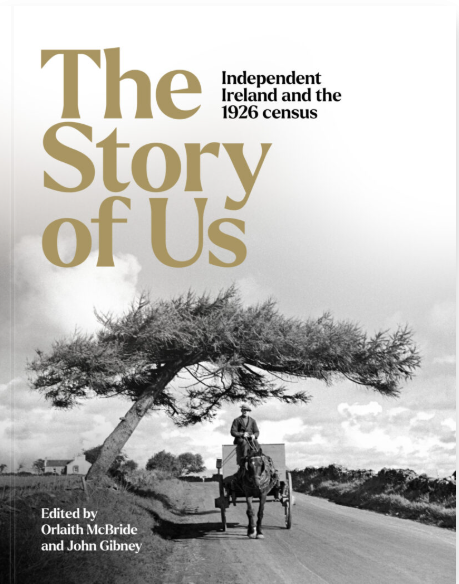
I don’t want to be negative about this amazing new free resource, but inevitably when a large dataset is transferred from handwritting to transcriptions and digital images, errors creep in. The newly released data was created with machine reading, OCR technology and human input. You can read more about the process in new book The Story of Us, which I’m working my way through at the moment and will review in due course.
One of the issues which seems to cause problems is the green writing which overlays the census return. These notations were done by statisticians. I’ve seen problems with ages read incorrectly and mistranscription from the Cló Gaelach to modern Irish.
The FAQ originally stated that the census is still undergoing checking and quality testing and they would catch errors themselves, but you could email with any that you spot yourself. I think it’s a mistake to not have a dedicated email address rather than the regular one, not least because everyone will see the embarrassing “we’ll get back to you in 10-15 working days” autoresponse. Director of the NAI, Orlaith McBride, is quoted in the Irish Times on Monday saying they do want want submissions on errors. I notice they have not stated how soon they’ll be correcting errors. The original website for 1901/1911 offered error correction on each page but it took well over a decade before any submissions were checked and amended.
As of 27/4, it has been slightly rejigged and they now say you should use the main contact form.
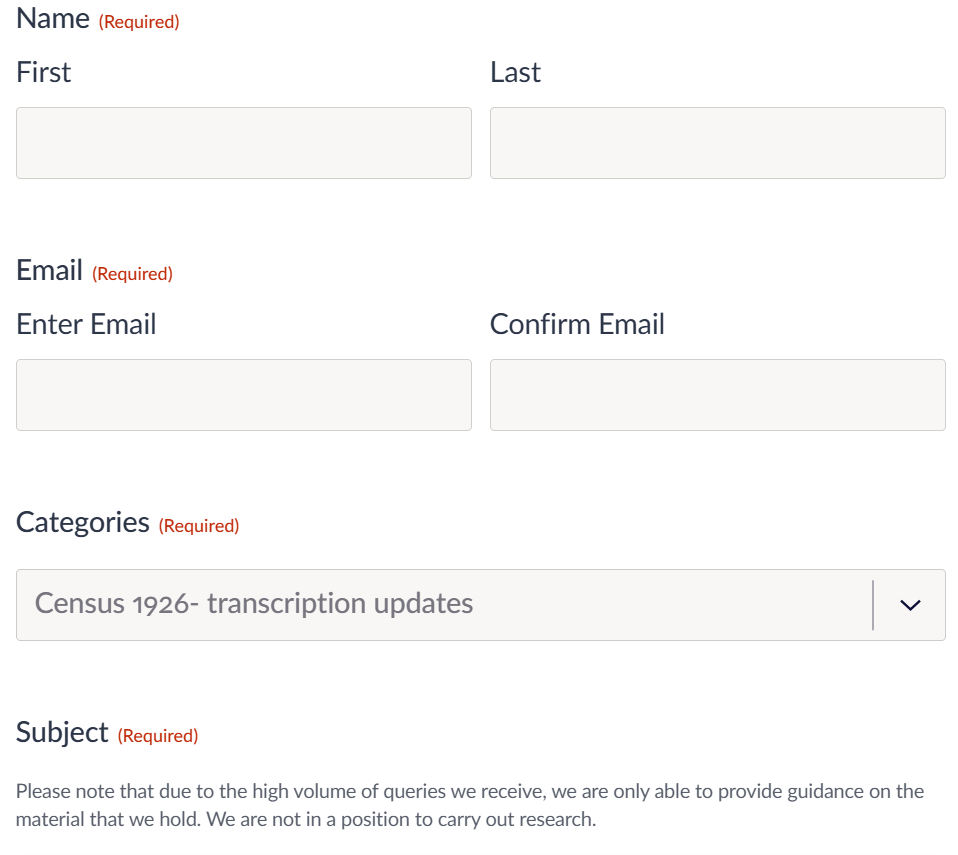
So if you’re going to submit an error report, here are some
Tips on error submission
Firstly, if the information is transcribed correctly but it’s wrong, they’re not going to correct that. So, for example, if your grandfather said he was 27, but you have his birth certificate and know that he was actually 29, that doesn’t matter. The census must accurately reflect what the person wrote.
Similarly, if someone misread the instructions and reversed their job and employer categories, that won’t be corrected either.
The same goes for spelling, and this is a biggie for people who aren’t used to Irish research, and many new explorers will be in this category. If your surname is O’Brien now, and the family wrote Brien on the census, this IS NOT WRONG. In the past, people switched with regularity between using an O or Mc surname and the version without. They were considered the same name. If your spell your name McCormick today and your great-grandparents spelled it Cormack in 1926, this is fine. So they won’t correct something like that.
With those caveats in mind, if you are submitting an error report, here’s my guidance.
- Link to the transcription of the return and note the problem. For example, Vincent Bradley is transcribed as being 20 years of age, but when I read the actual return, he is 6 months old. The green ink is largely at fault here. I also notice that the Form B is missing for this household, so I’ll include that in my email.

- Don’t add commentary or blame!
- Don’t send it again if they haven’t fixed it in 3 or 6 months.
- If you’re using the census a lot and finding several errors, you might decide to send one email with a number of suggested corrections, rather than one per issue.
When you do send an error email, thank them for all their hard work too!
Great advice, Claire. I especially like your reminder to add thanks to emails 🙂 I am looking forward to your review of the book. My order is likely on a slow boat from Ireland to Seattle. Sigh. It’s moments like this momentous record release, and all the events/publications around it, that make me wish I was on the ground in Dublin right now. I am enjoying all the programming I can access through the RTE player and online. I have particularly enjoyed Liz Gillis’s podcasts (Come to Your Census).
I have Liz Gillis’s podcast ready to go too!
Hi if like to just say that Upper Stephen st Dublin 2 has Lower Stephens St residents on the there list only one side of Lower Stephen st
on the list .
Many thanks
Tony Flynn.
Definitely one to let the NAI know about!
What of all the people trying to research their ancestors who were living on others’ lands at the time… For instance Kate Kearney’s Cottage in Piperstown. Kate Junior was part of my extended family so I wondered if I would be able to find her as she was age 19 in previous Census and women generally married. Lo and behold, there was Kate, single living alone at the farm. However, on clicking the “Outbuildings” etc. here we find 50 other people accounted for (2 of them also related to me) but in each case they only list the Head of the Household, so all the wives and children living under such arrangements at commercial properties around the country dont get a mention – nothing our guys can do now if they were omitted from the census records but something to be aware of. Its the same over at Farmleigh House which is WAAAAY buried with many many other properties under the Surname Murray of Castleknock (I wanted Scribblestown but found out that is modern-day Castleknock). There are somewhere between 600 and 1,000 people lost in here in vast land holdings by one family. (The count is not carried faithfully from page to page of the 12-page return)
When you find the list of heads on the enumerator return – you need to go back to the search and find each of those people, and look at their household return. Everyone should be there, unless there’s a technical error. I’m not sure what you mean about Murrays in Castleknock, but please do report that to the National Archives.