It sometimes surprises those whose Irish ancestors left the Emerald Isle a long time ago that more records are not in the Irish language.
The main reason for this is that most of the extant records date from a time when Ireland was ruled by Britain. Administrative records are all in English. We do have some Roman Catholic records in Latin too.
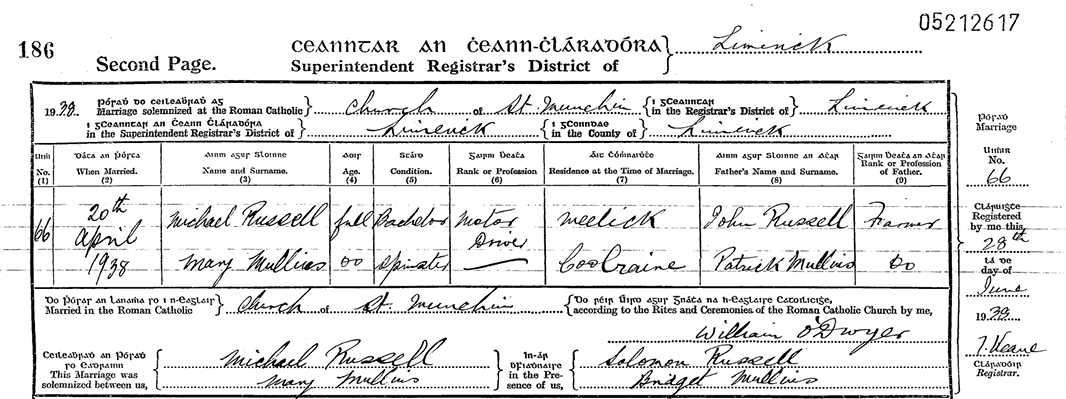
After Independence in 1922, the Irish Free State began to use Irish and English on all forms. This is why on the newly released 1926 has all the explanations in both languages and the form was printed double-sided allowing citizens to decide which side to complete. The Irish of that period used a script called the Cló Gaelach, which was reformed in the 1950s, so the Irish we learn at school today used the Roman alphabet just like all western European languages.Irish has three main dialects corresponding to three of the four provinces (there is no Leinster dialect). As we advance through 20th century record releases, we will see more Irish on them. You may have already noticed the civil records become bi-lingual in the 1930s.
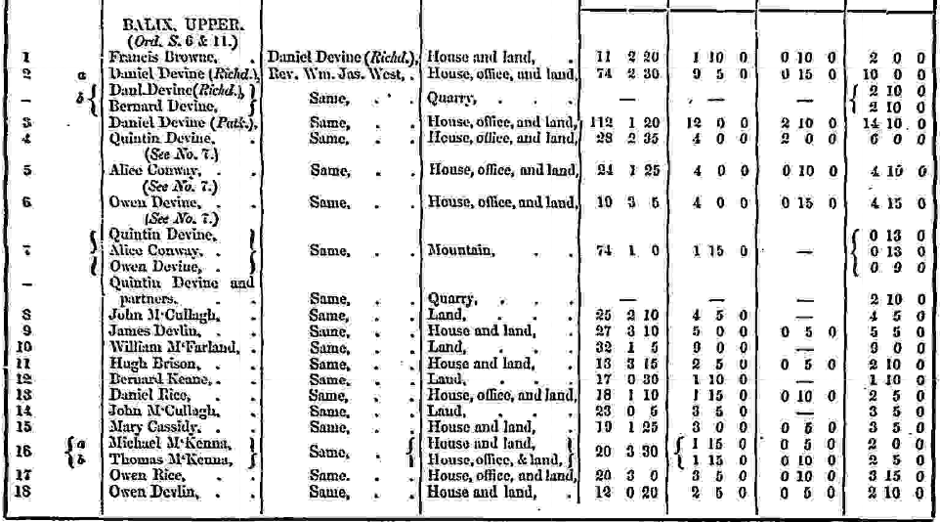
Occasionally, the land records give up little hints of people using Irish in day-to-day life, even when their information has been written in English. For example, Griffith’s Valuation and its later revisions, as well as the earlier Tithe Applotment Books and land rentals will often show a name in the format “Thomas Murphy (Michael)”. This usually indicates the presence of a second Thomas Murphy in the area. Their respective fathers’ names would be in brackets to differentiate the two men. You can see this on the below example from Griffith’s Valuation of Balix Upper in Co. Tyrone in 1859. There are two different Daniel Devines.
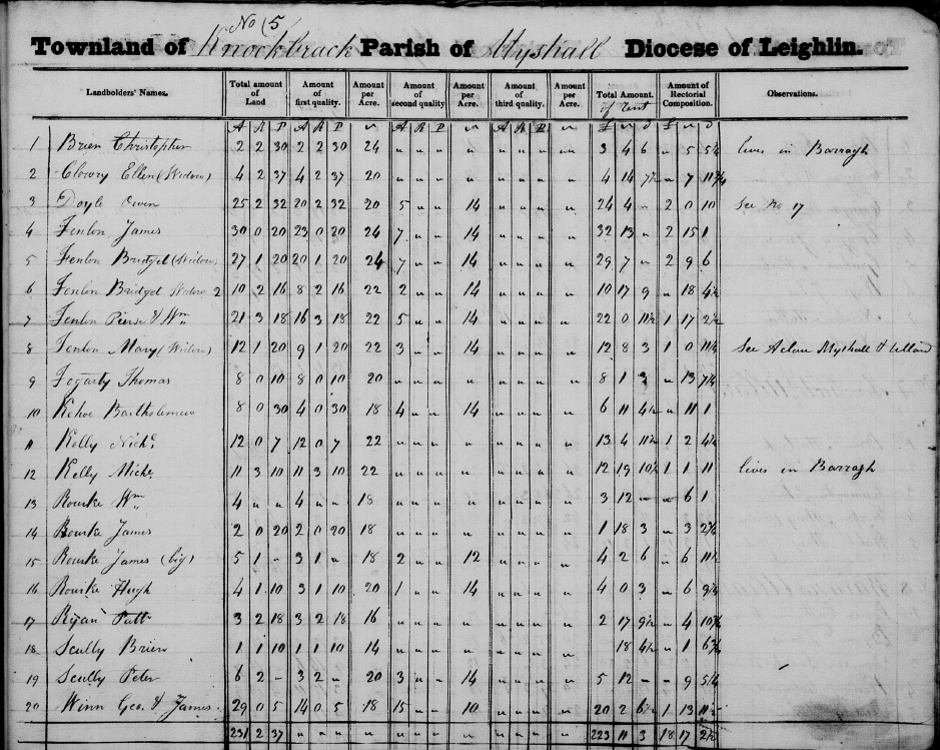
Senior and junior to denote a father and son (or two other related men sharing the same name) was also not used. In Irish, the older man would use Mór, which literally means big. Instead, you might see Big after one name. This is shown in the example from the 1827 Tithe Applotment Book from Knockbrack, Co. Carlow. James Rourke (big) is shown at no 15 and by inference, James Rourke, the younger or “Beag” meaning small, is above him.
Something that people often have a hard time getting their heads around in genealogy is cousin relationships and what removed means. It’s easy to explain a first cousin – two people who share a set of grandparents (seantuismitheoirí). A first cousin once removed occurs when the two people have recent common ancestors but they’re not the same generation. For one person, they are their grandparents and for the other, great-grandparents (sin-seantuismitheoirí). This is something which Irish does in a very neat and clear way using odd and even numbers. In Irish, we have special versions of the numbers for counting people.
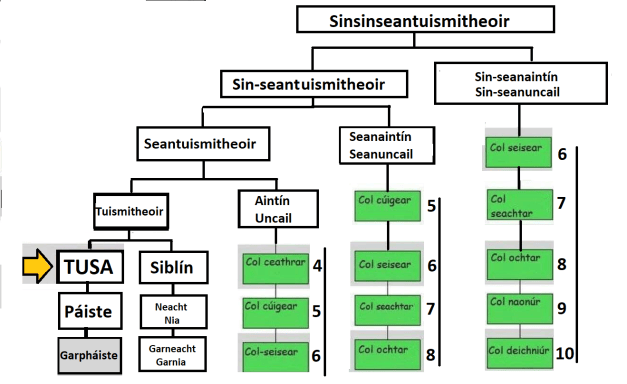
You might recognise this chart, if not the words on it. There’s many versions of this relation chart on the internet, but this one is in Irish.
The Irish for a first cousin is “col ceathrar”. The “ceathrar” means four people and indicates the number of people involved in the relationship – person A, their parent, their sibling, their child (person B). Multiple first cousins are “col ceathracha”.
The Irish for a second cousin is col seisir. “Seisir” meaning 6 people. Multiple second cousins are col seisreacha.
The Irish for a third cousin is col octair – where “octair” means eight people – also used for multiple third cousins. A set of 2 people who share great-great grandparents being a chain of 4 people up, a sibling and 3 down.
The Irish for a fourth cousin is col deichniúr – 10 people, with the bottom two sharing great-great-great grandparents. Many in the diaspora will have a lot of third and fourth cousins here in Ireland.
To denote a removed relationship in Irish, you switch to odd numbers, so a col cúigir is a first cousin once removed (5 people involved) and the same word is used for multiples. A second cousin once removed or multiple 2c1r are col seachtair (7 people in the mix). A third cousin once removed is col naonúr.
While we can get into more than one removed, it confuses people, so try to take it back to the easiest version. My grandfather’s first cousin is the same as my first cousin twice removed but one is much more easily understood.
With thanks to Darach O’Seaghdha, author of the fantastic Motherfoclóir, for providing the chart and to Máire Mac Conghail for further help. Why someone who studied Irish for 14 years at school isn’t fluent is an entirely different story!
A great follow up would be to cover consanguinity
Actually, I have a blog covering that from 2 years ago!
https://vgr33xcddgq.c.updraftclone.com/consanguinity-dispensations/