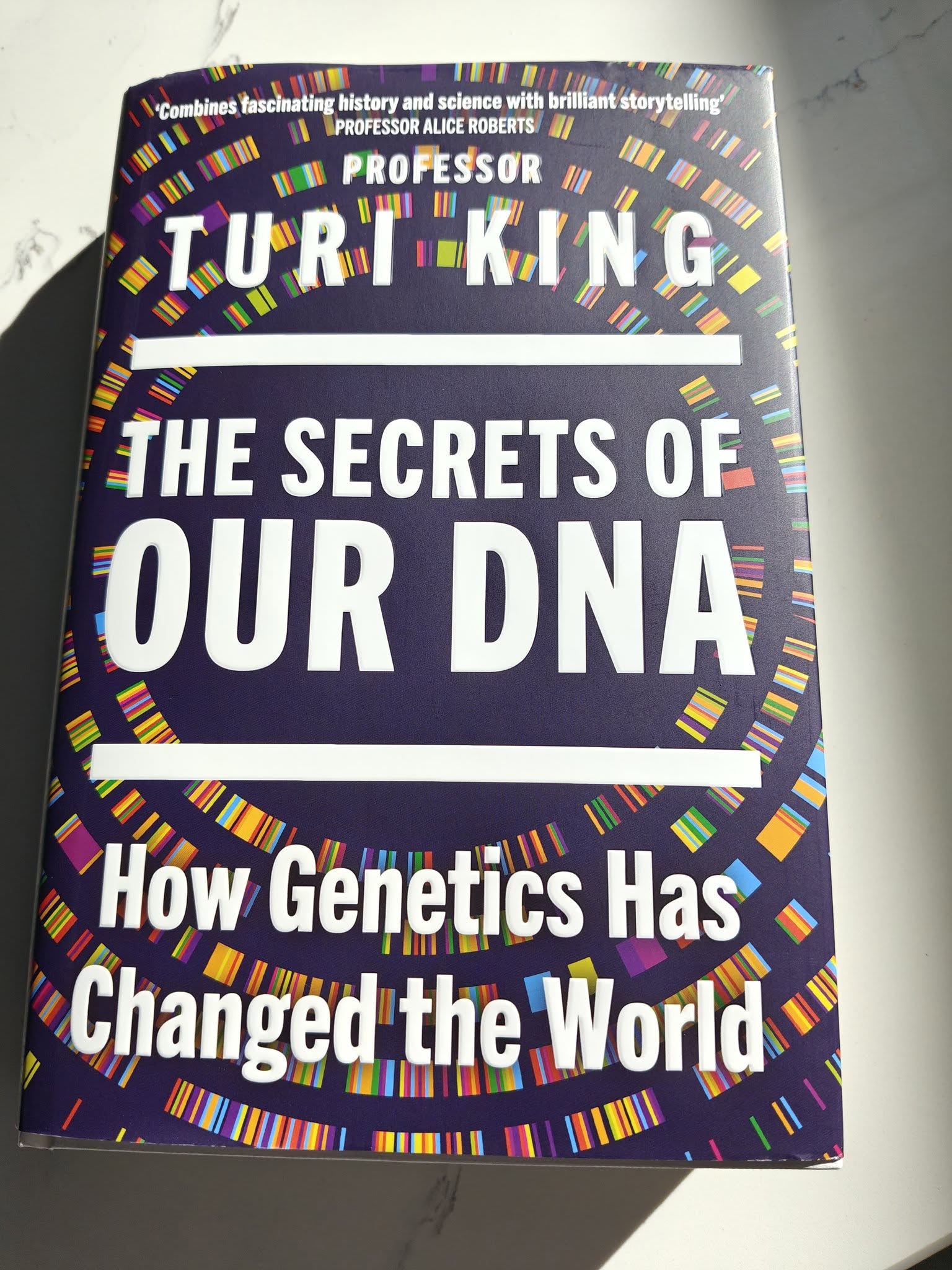
The Secrets of our DNA – how genetics has changed the world is a new book by Professor Turi King. She is best known for leading the identification of Richard III’s skeleton in Leicester. She also presented the show DNA Family Secrets on BBC with Stacey Dooley. I also know Turi a little and we’ve even met once. However, this review is unsolicited and I bought my own copy of the book.
Coming in at almost 500 pages, this is not a short read. As you’d expect from a scientist, it’s well-referenced and has an index. I’d prefer footnotes over the endnotes used in this edition but I can understand why a publisher might choose them to make a book appear less intimidating.
12 chapters run through a history of genetics as a field from Sir Alec Jeffreys (Turi’s mentor) originating the DNA fingerprinting process in the 1980s to the present. This early section does cover similar ground to Adam Rutherford’s A Brief History of Everyone who has ever lived. But this book comes right up to date with discussions of genetic genealogy, forensic investigative genetic genealogy (FIGG), the ethics of CRISPR, eugenics and King’s involvement in mapping Hitler’s genome, which was itself the subject of a 2 part documentary earlier this year. It even discusses the use of animal DNA in criminal trials and how it was used to identify horse meat in what should have been only beef products.
The impact of Angelina Jolie’s decision to have pre-emptive surgery after discovering she had the BRCA gene which causes breast cancer, and how this led to a lot of women having tests (something Kylie Minogue and Jade Goody’s similar announcements did) are handled with sensitivity.
I particularly liked the chapter breaking down some early uses of DNA in criminal trials such as O.J. Simpson. While I was familiar with the case, I hadn’t realised quite how overwhelming the DNA evidence was.
I really enjoyed reading it, though people who are not very sciency might find a couple of the chapters a bit of a slog. Turi’s strong moral sensibilities are clear and she’s not afraid to say that we need better codes of conduct when it comes to editing genes and how this technology is handled. If you like popular science as a field, then this belongs on your shelf. If your only interest is how DNA can help your genealogy, there’s plenty here for you too, but you might end up skipping a couple of chapters. It’s well worth your time and money.