It’s time for another book review. Regular readers of my blog will know that I’m keen on people getting the fundamentals of how to research your family tree right. This isn’t a topic that fills us with excitement but it’s important. Dr Karen Cummings (owner of Pharos Tutors) is someone I know professionally and I took a course taught by her 7 years ago, but she didn’t ask me to write this review and I bought my own copy of the book.
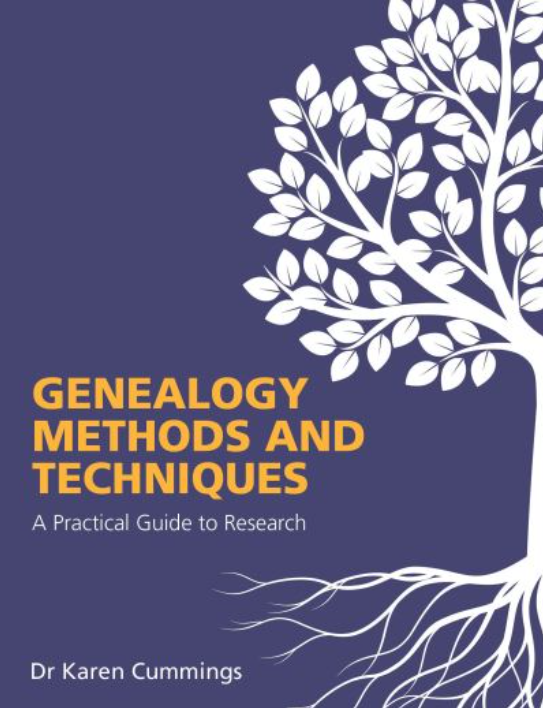
It’s a bigger sized book than I expected: 28 x 19cm and it’s floppy, so you may want to read it at a table or propped up. Running to just 175 pages, it’s a quick read too. This is important because you wouldn’t want a serious text book to be too daunting.
11 chapters cover getting started, teaching the reader how to research, find sources, evaluate them, critical analysis of discrepancies and record your findings. Each chapter builds on the previous one and ends with a lovely summary of the key points and actions to follow. Karen is English so all the examples in the book are of English records and mostly from her own family tree. This doesn’t mean you can’t use this book if your ancestors came from elsewhere: you absolutely can take the guidance and apply to research in any country. The case studies also grow nicely through the chapters and show how Karen resolved issues within them.
As an Irish reader, I was amused to see how Karen walked readers through searching a wider time frame for someone’s birth than just one or two years. I just automatically presume people had only a vague notion of their age and always search at least 5, if not 10 years around the suspected year of birth. This is a legacy of Britain having adopted civil registration of births 27 years before Ireland did.
There is an extensive section on how to build citations and different styles. I’m going to say something that’s maybe a little controversial here: as long as you are consistant with how you display your citations and someone else could easily recreate that research, I don’t think it matters what way you do it. But that opinion comes from years of practice and for a new hobbyist, this is more important to get right at the start.
Karen also talks a lot about research logs, how to display them, the importance of timelines and certainly gave me some new ways of thinking about how I do these things. I’m unlikely to adopt mind maps any time soon but they do look pretty.
If I had any tiny complaints, it’s that the chapter on DNA at the end feels tacked on. It’s a decent but very short summary and I think it feels a little out of place. DNA is such a big deal in terms of proving research theories now that the author couldn’t have left it out, but it deserved a longer section.
As methodology books go, this is up there with Andrew Todd’s Nuts & Bolts for me1. Karen does actually reference him in a couple of places too. Definitely worth the money and worth refering to again after you read it. Get your own copy right away. I’m going to be recommending it to my students.
- Out of print but worth finding a second-hand copy. ↩︎