Within the Roman Catholic Church, couples needed a dispensation to marry if they were related to each within a certain degree. The rules were laid down by the Fourth Lateran Council in 1215. If a couple shared great-great grandparents or closer, then they needed a dispensation. Depending on how close, this might be granted at parish, diocesan (bishop) or papal level. In reality, this meant paying the church an extra fee.
Of course, this required the couple to know about their own connection. Take a moment to consider now, ignoring your genealogical habit, how many of your third cousins you could identify by sight. I’d venture none. Communities in Ireland were smaller in the 18th & 19th century. Before the advent of trains and bicycles, people rarely travelled very far to meet a marriage partner (if they didn’t emigrate). Growing up, I knew a couple of my second cousins because they lived in the same town and my mother had introduced me to them. However, my brother was actually friends with a second cousin in secondary school for a couple of years before a chance remark about the unusual name of said friend’s mother caused the discovery of their relationship!
You might wonder why couples didn’t just lie about a relationship to avoid paying more money. The very fact that communities were smaller in the past meant that it was harder to hide a distant connection, particularly when the banns were being read out three Sundays in a row at Mass. Also, it’s hard for modern people to understand the very real grip of the Catholic Church on people’s day to day lives.
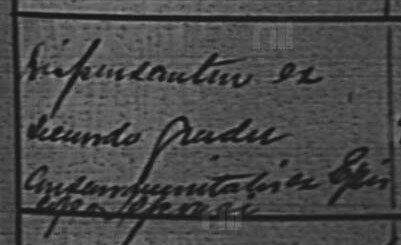
So what does a consanguinity dispensation look like on a marriage register? It will say something like “2nd and 3rd degree”, probably in Latin. You do see the degree written with the symbols “2° and 3°”. Here’s an example from St. Paul’s Arran Quay parish in 1862 for the first cousin marriage of John Joseph O’Connor & Anne Patterson. Translation: dispensation for second degree consanguinity obtained from the husband’s bishop.
But how do you work out the connection if you find a note like this on a parish record? To help you with this, I’ve put together a little table.
| Consanguinous Degree | Common Ancestor | Relationship |
| 2nd degree | Grandparent | 1st cousin |
| 3rd degree | Great-grandparent | 2nd cousin |
| 4th degree | Great-great grandparent | 3rd cousin |
Remember that people might not be the same distance to the common ancestor, which is how you get a third and fourth degree relationship. In that case, the couple would be second cousins once removed.
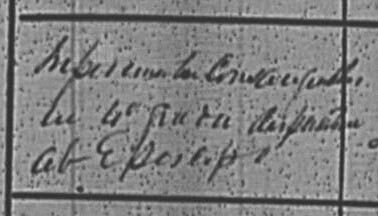
When Thomas Delahunty and Margaret Tobin married in Kilkenny in 1875, they recorded a dispensation in the fourth degree on the marriage register. This might be the only proof that Margaret and Thomas were third cousins, but if they were my ancestors, it would certainly add to knowledge of them. Records probably don’t go far enough back to document the connection.
For more on this and the related (pun intended) field of affinity, I highly recommend this article by Lynn Serafinn, an Italian-American genealogist.
Have you found any examples of consanguinity in your family? Let me know in the comments.
This is great information Claire – thank you for posting! I have 2 ancestors who were definitely related to each other (same last name – same little townland) but I am not sure of the degree. Does the fact they were married by the parish priest rule out 2nd degree consanguinity? I have their Marriage Cert but unfortunately the register is for Glenties is not online for 1878. Thanks!
Hi Kelly – I don’t think you can rule it out yet. If the parish register existed in 1878, then it is worth contacting the parish now to ask if they’ll check it for you. Offer a small donation to cover their time.
Hi Claire, this is really useful information.
I’m researching families in N. Ireland and I’ve found a couple of almost identical-looking dispensations. The text looks like “a dispensation in 3 D 3 [something in superscript] consanguinatis gradibus in this case was obtained”.
I can’t post an image here but you can see one of them at https://registers.nli.ie/static/low/000633233/vtls000633233_090.jpg – right-hand side, 7th Dec. marriage of Edward McAleese and Mary McCluskey
How should I transcribe and interpret the “3 D 3 xx” part?
Hi Dave,
I can’t zoom the image up enough to read it properly.
Can you tell me the parish and date & I’ll look it on the non static version of the page?
C.
Hi Claire,
The parish is Loughguile – first film in the list, image no. 90.
The date at the top of the page is 2nd November 1850. The wedding with the dispensation was on the 7th.
This link might be easier to read:
https://registers.nli.ie/static/high/000633233/vtls000633233_090.jpg
Thanks!
Dave
So it’s a 3 & 3 degree – which means second cousins.
My Latin cases aren’t great but translated it means “granted a dispensation for 3rd and 3rd degree consanguinity”.
Hi Claire,
Thanks very much for your help!
Dave
You’re very welcome.
Thanks for your post. I have an example from 1839 Williamsville NY but I’m having difficulty confirming the degree of consanguinity.
Here is the link – its the bottom marriage on this page with the comment at the far right. Schneider to Schneider.
https://www.familysearch.org/ark:/61903/3:1:3Q9M-CSMZ-898B-8?cat=22157&i=79&lang=en
I suspect they were first cousins, their father’s being brothers, but I don’t clearly see 2nd in the notation. Any thoughts? Thanks.
Oh it’s not a great image, is it? I don’t see a 2 either. Could you contact the church to try and get a clearer image in colour?
Thanks for your input. It is very difficult to decipher.
0500706, Aghabulloge – Catholic Parish Registers at the NLI.jpeg. At my 2GGPs wedding on 1848, July 15 between Edward John Murphy and Maryanne Riordan in Coachford , W Cork , their respective fathers, Mathew Riordan and Jeremiah Murphy (my 3GGFs) were granted dispensation (episcopal?) as they were related by the third degree consanguinity thereby sharing one set of the same GGPs.
Great find. Do you mean there were 2 generations of dispensations?
Hi Claire,
I found your explanation, and particularly the table, very interesting and helpful. I have an example of consanguinity in my family. My great-great grandparents were first cousins.
Joseph Byrne and Bridget Byrne married on 2 November 1871 in St. Catherine’s church Meath Street, Dublin. The marriage cert translation says “impediment of consanguinity according to the second grade dispensed by His Eminence Paul Cullen”. I presume their fathers were brothers but I am now stuck in my research.
Margaret
Yes, that’s right. The church marriage also gives each person’s mother’s name, so you’ll need to try and identify marriages for those couples, which should give you the common grandfather. Byrne is a very common name in Dublin though so make sure to do elimination work to avoid other families that with the same names.
This is very useful information, and I really appreciate your little table.
I have several records of consanguinity in my family tree, the earliest of which (1823 marriage record from Muintervara, Cork) reveals that my 3x-great-grandparents were third cousins. I also have a pair of great-grandparents who married as first cousins (yikes!): they received a dispensation from Rome to marry in Ottawa, Canada.
Thank you! I made it because I kept having to look up the details myself – can’t keep them in my head!
First cousins as a one-off is nothing to worry about.
I have a 3rd and 4th dispensation on my tree, I can’t figure out what it means though! Both parties had Cronin as their surname.
Second cousins once removed.
I thought it might be, but wasn’t sure, thank you.
You’re welcome.