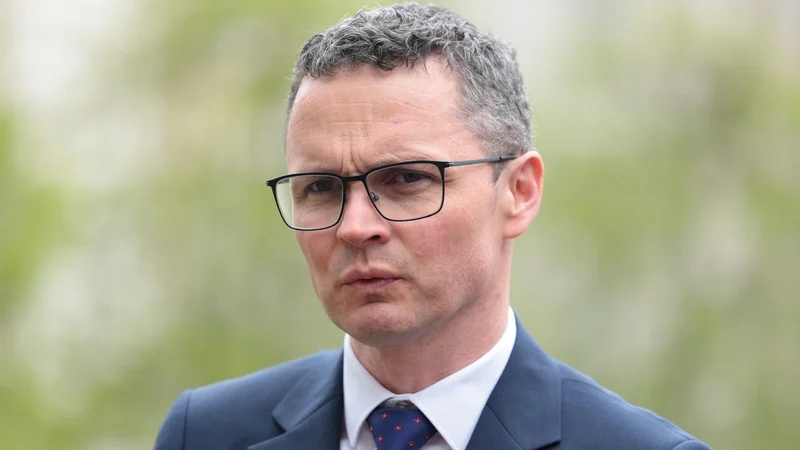
T-minus 41 days to 18 April 2026. On that day, professionals, family historians, hobbyists and regular historians will be sitting at their desks hitting refresh while we await the first Irish census release in more than 50 years (if we count the microfilm release of the previous two in the 1960s!) The Dept of Culture, Communications & Sport (headed by Patrick O’Donovan) will be hoping for a nice tourism bump.
The National Archives has a page on the plans for the release, which include launches in various locations around the world, a documentary and an exhibition. They also have a page for centenarians who can opt out of having their data released.
Just as a reminder, this release covers the 26 counties of what is now the Republic of Ireland, so it does not include the 6 counties of Northern Ireland. While they did take a corresponding census that year, it has not survived. Their next census is in 1937, so another 11 years to go there.
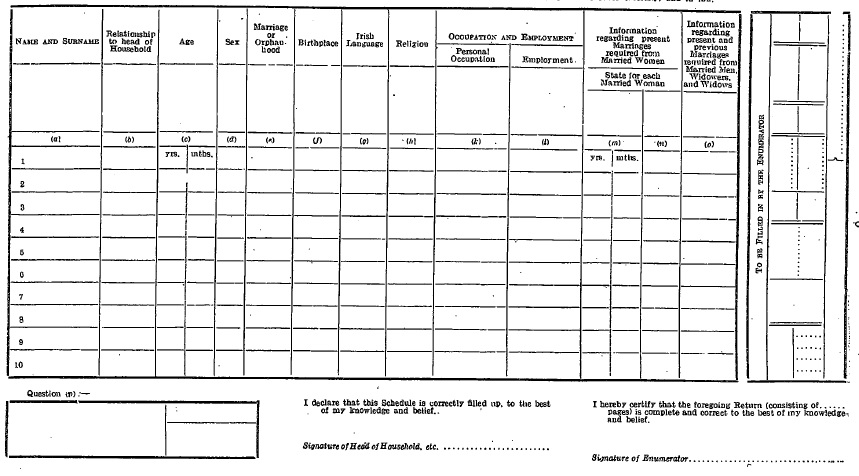
Below you can see an image of the blank form used in 1926. Details collected included name, age, sex, marital status, birthplace (more precise than previous censuses), religion, occupation plus employer as well as details about length of marriage (for both currently married and details about past marriages for those widowed), ability to speak Irish. People in hospitals, prisons, workhouses or army barracks will have their full names displayed, unlike previous censuses, but they aren’t on a different kind of form.
The Irish statute book gives more details on the categories with examples.
So how can you prepare? Bookmark the new census site. It’s been live since last year with the 1901/1911 data but the old url still operates in parallel. The new census will only be on the newer link. 1926 isn’t going to be available on commercial sites either. While you’re at it, save your old links & the corresponding images for 1901/1911. I expect they will take the old site down relatively soon. This will mean that any links to the census in your online trees won’t work. If I get any definitive details, I’ll post about it separately.
I’ve made a list of people I want to look up and where I expect them to be and what age they would have been in 1926 and where they are likely to be. First up: my grandparents, who were all under 10 in 1926 so it’s the first time I’ll see them on the census. In fact, 18th April was the birthday of one of my grandmothers, so I’ll start with her. Being small children, that should net me my 8 great-grandparents on the same 4 returns, but you never know! One of my great-grandfathers was in the Irish army at this time, so he might have been elsewhere on the night. A further one might have been working away from home, having started a new job in Ballymena a couple of months’ earlier (I’ve speculated before about whether this whole family moved with him immediately from Limerick or they went in stages).
After that, I’ll hit up my various 2x great-grandparents who were still alive in 1926 – going through my tree, it looks like 5/16. All of my earlier identified direct ancestors were dead by then.
So on that first day, it’ll be all about my own family history, but inevitably I’ll be turning to my client’s families in due course. Over the past decade, there have been many times where I wished for the 1926 on a client project. Something tells me I might be checking up on a few of those, even though the projects are long completed! I’ve also got some current clients where we’re hoping this new census will give us a fresh angle for research. I’ll certainly need fodder for the many upcoming talks I have on this census and the articles I’m writing for magazines on it.
If your ancestors left Ireland before 1926, you can still have fun here. Why not try some descendancy research on your ancestors’ siblings who were still in Ireland then? Another interesting thing to do is look up some famous Irish people who are likely to appear on the census. I’ve included a few ideas below, some of whom were not yet famous:
- Countess Constance Markiewicz – our most significant female revolutionary leader
- WB Yeats – poet & Nobel Laureate
- Jack B. Yeat – his brother, artist & Olympic medallist
- Archbishop John Charles McQuaid – an extremely (too) influential priest
- Hanna Sheehy-Skeffington – suffragette & feminist
- Dr Kathleen Lynn – doctor, revolutionary & reluctant politician
- All Taoisigh (prime minister) up to & including Garrett Fitzgerald
- Every Irish president up to & including Patrick Hillery (that’s mad, he only stopped being president in 1990!
ETA: this article was originally published in January 2025 & updated on 7th March 2026 to add extra details.